In the fast-paced digital economy, establishing a distinct brand identity is crucial for business survival. Whether launching an e-commerce platform, a digital marketing agency, or a software-as-a-service (SaaS) product, safeguarding your intellectual property is paramount. In India, trademarks are governed by the Trademarks Act of 1999 and regulated by the Office of the Controller General of Patents, Designs, and Trademarks. Before initiating any steps, founders must clearly understand what elements qualify for legal protection and what the law strictly rejects.
The entire procedure has grown remarkably streamlined with the advent of online trademark registration, allowing applicants to file applications, upload digital signatures, and track progress via the official e-filing gateway. However, possessing a digital platform for submission does not alter the fundamental substantive rules of what the registry will accept. Knowing the precise boundaries prevents unnecessary legal objections, financial losses, and rejection by trademark examiners.
What Can Be Trademarked Online in India?
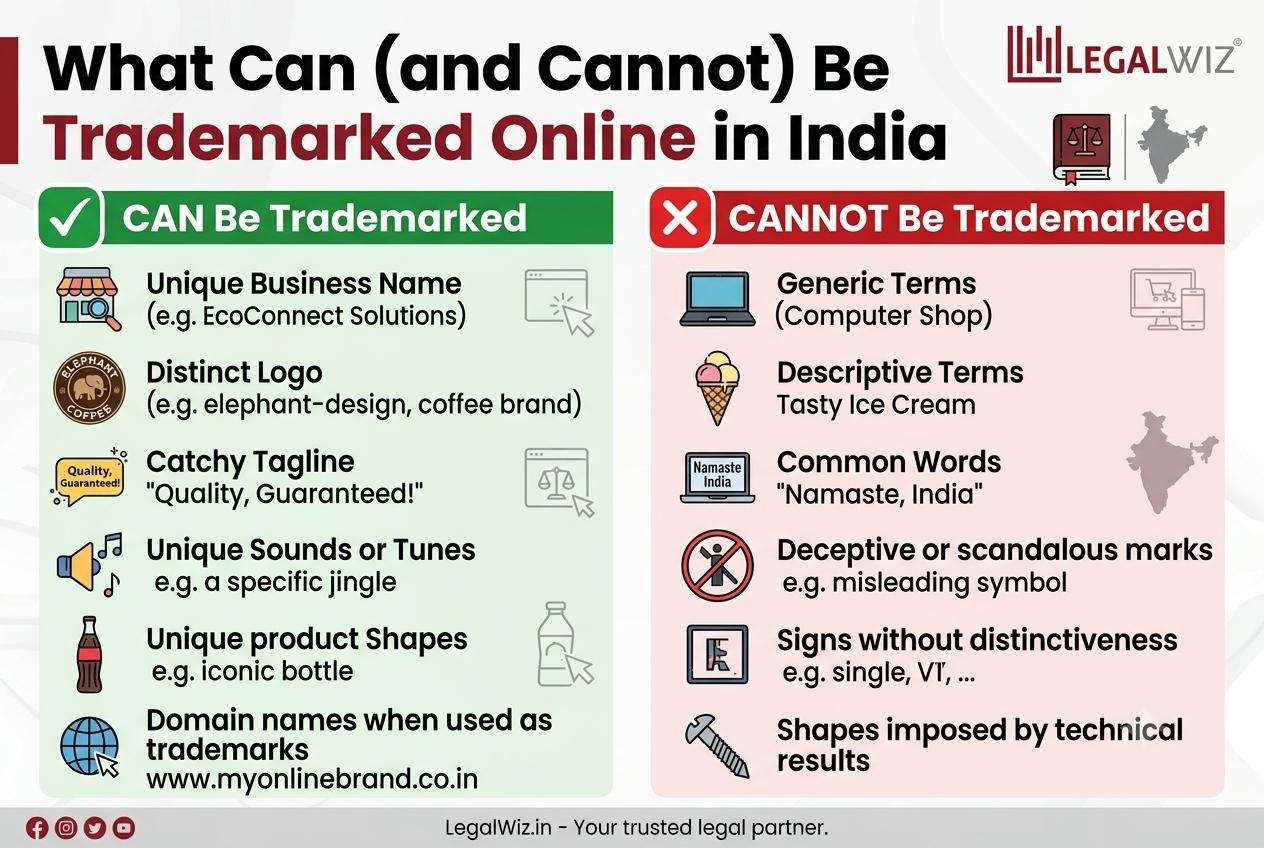
To secure legal ownership, a mark must possess distinctiveness and act as a source identifier for goods or services. The Indian trademark registry accepts a wide variety of visual and non-visual elements:
- Words and Names: Invented or fanciful words (like “Kodak”), arbitrary words used in a non-descriptive context (like “Apple” for computers), and personal names or surnames provided they have acquired distinct market secondary meaning.
- Logos and Symbols: Graphical representations, unique artwork, corporate logos, and distinct color combinations (such as Cadbury’s purple).
- Slogans and Taglines: Catchy advertising phrases that consumers immediately associate with a specific brand experience.
- Non-Traditional Marks: Unique 3D shapes (such as the contour of a Coca-Cola bottle) and distinctive sound marks (like the Intel chime or Nokia tone) that carry immediate brand recall value.
What Cannot Be Trademarked Online in India?
The law explicitly blocks certain categories from receiving a monopoly, ensuring fair market competition and protecting public interest. The registry will reject applications that fall into these prohibited criteria:
- Generic Terms: Everyday words that describe the product category itself (e.g., trying to trademark “Laptop” for computer hardware) cannot be owned by a single entity.
- Purely Descriptive Marks: Words that merely describe the quality, function, or geographical origin of goods (e.g., “Sweet” for confectionery or “Mumbai Spices”) are barred.
- Deceptive or Misleading Marks: Signs that intentionally confuse consumers regarding the origin, material, or quality of the offerings.
- Offensive or Immoral Content: Marks that hurt religious sentiments, contain vulgar expressions, or violate public morality and current laws.
- Prohibited Emblems: State symbols, national flags, and names restricted under the Emblems and Names (Prevention of Improper Use) Act.
Navigating the Approval Process
Filing your paperwork correctly is only half the battle; the chosen mark must clear examination and public scrutiny. Prospective applicants often complete online trademark registration in india by partnering with legal experts or navigating the IP India e-filing portal independently using a Digital Signature Certificate (DSC). Applicants must carefully select the correct Nice Classification category (ranging across 45 distinct classes for goods and services) to ensure accurate legal protection. If an examiner spots similarities with existing entries or flags the mark as descriptive, an official examination report objection will be issued, requiring a formal legal reply within 30 days.
Conclusion
A legally protected brand asset serves as a powerful shield against market copycats and elevates overall enterprise valuation. By filtering out generic terms, deceptive layouts, and unoriginal concepts, business owners can focus their branding efforts on creative, distinctive identifiers that sail smoothly through the approval pipeline.
FAQ
1. Can domain names be trademarked in India?
Yes, but only if the domain name is actively used to brand and sell unique goods or services in commerce, rather than just being held as a website address.
2. Are social media handles or usernames protectable?
Partially. A social media handle can be registered as a trademark if it is used distinctively to identify your business’s commercial goods or services, not just as a personal or generic profile name.
3. Can I trademark a website’s overall look and feel (UI/UX)?
No. The general user interface, layout, or design of a website falls under copyright law, though specific brand logos displayed on the site can be trademarked.
4. Can source code or software algorithms be trademarked?
No. Source code and software logic are protected by copyright and patents (under strict conditions), not trademarks. However, the software’s commercial name and logo can be trademarked.
5. Can a generic hashtag become a registered trademark?
Generally no. Hashtags are usually considered descriptive or promotional tools. They can only be trademarked if consumers specifically recognize the hashtag as a unique indicator of your brand’s origin.